
Your skincare routine doesn’t need to become complicated just because you’re getting older.
In fact, the most effective approach is usually the opposite: build a simple routine, protect your skin from the sun, moisturize consistently, and add targeted ingredients only when you actually need them.
Your skin can change throughout adulthood. Oiliness, dryness, sensitivity, pigmentation, acne, fine lines and changes in texture can all become more noticeable at different times—and there’s no single routine that works for everyone.
That’s why your 20s, 30s, 40s and 50s shouldn’t have completely different skincare rules. Instead, think of each decade as an opportunity to adjust your routine according to your skin’s current needs.
Dermatologists consistently emphasize sunscreen and moisturizer as foundational skincare habits, while targeted ingredients can be added depending on concerns such as acne, dark spots, uneven texture or fine lines.
This guide walks you through what to prioritize at every age, how to build a morning and evening routine, which ingredients are worth understanding, and how to avoid overwhelming your skin with too many products.
Important: This is general skincare information, not individualized medical advice. If you have persistent acne, eczema, rosacea, unusual skin changes, or another skin condition, a dermatologist can help you choose appropriate treatment.
Table of Contents
- Does Your Skincare Routine Really Need to Change With Age?
- The Skincare Basics That Matter at Every Age
- Skincare in Your 20s
- Skincare in Your 30s
- Skincare in Your 40s
- Skincare in Your 50s
- Age-by-Age Skincare Comparison
- Morning Skincare Routine: Step by Step
- Nighttime Skincare Routine: Step by Step
- Skincare Ingredients Explained
- How to Introduce Retinol Slowly
- How to Build a Simple Routine From Scratch
- Skincare Mistakes to Avoid
- How to Choose Products for Your Skin Type
- When to See a Dermatologist
- Frequently Asked Questions
- Final Takeaway
Does Your Skincare Routine Really Need to Change With Age?
Not necessarily.
There’s a common idea online that you need a completely new skincare routine every time you enter a new decade.
That’s not how skincare actually works.
A 22-year-old with dry, sensitive skin may need a very different routine from a 22-year-old with oily, acne-prone skin.
Likewise, two people in their 50s can have completely different concerns.
Age can influence what your skin needs, but your individual skin condition should guide your routine more than the number on your birthday.
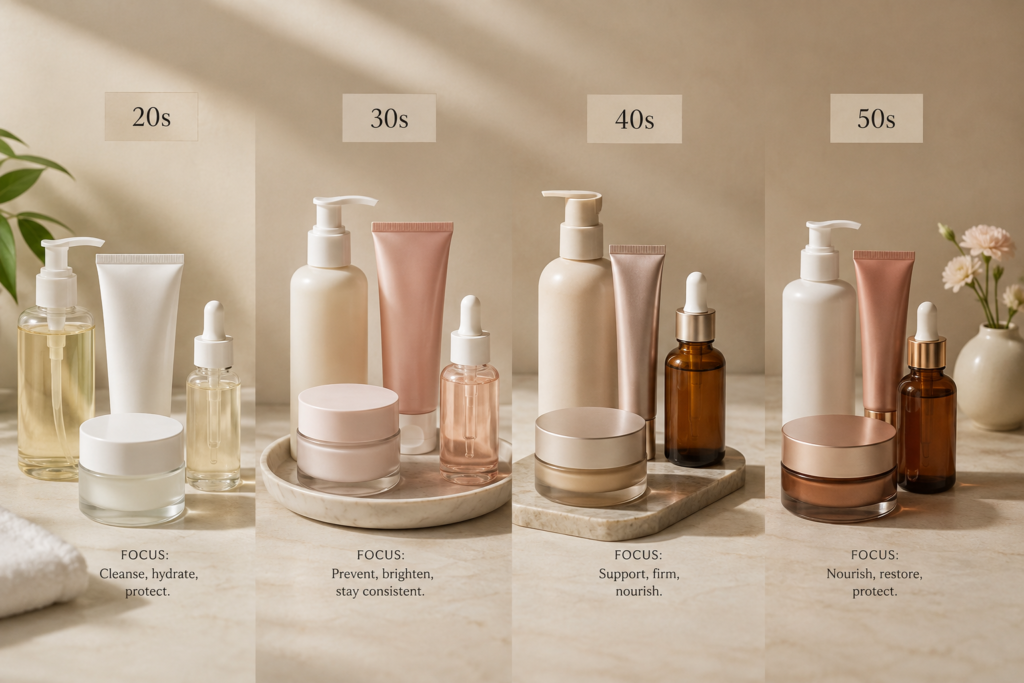
A useful way to think about it is:
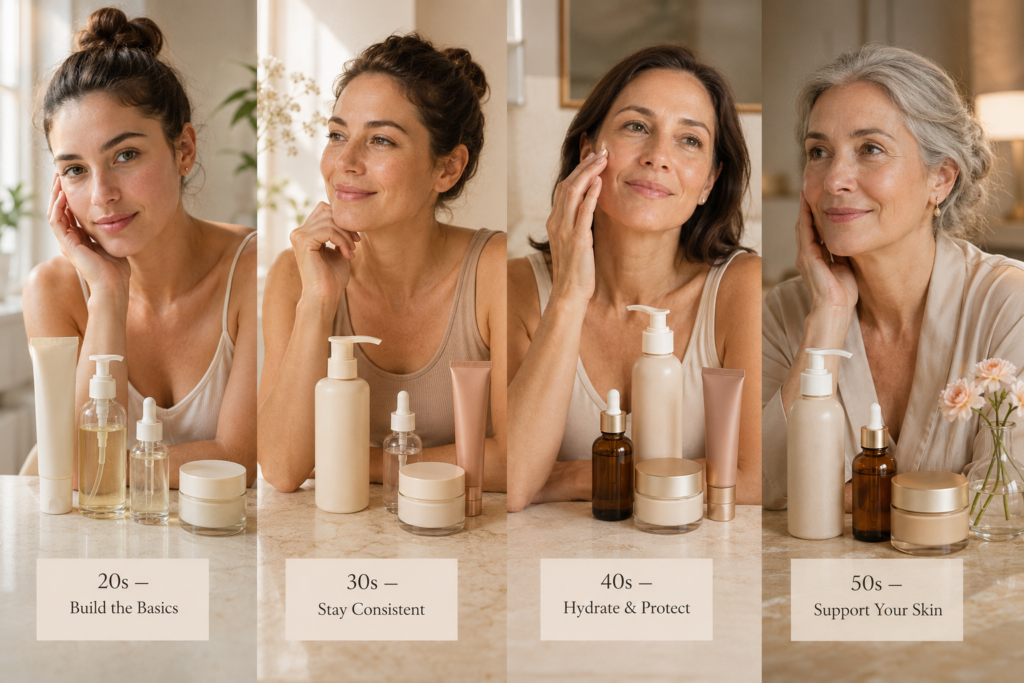
Your 20s
Build good habits.
Your 30s
Maintain consistency and address specific concerns.
Your 40s
Focus more on hydration, texture and signs of photoaging.
Your 50s+
Prioritize barrier support, hydration and continued sun protection.
But there’s one thing that should remain important throughout all four decades:
Sun protection.
Dermatologists recommend broad-spectrum sunscreen, with SPF 30 or higher commonly advised for daily protection, alongside other sun-protective measures.
The Skincare Basics That Matter at Every Age
Before discussing individual decades, let’s establish the foundation.
You don’t need ten or fifteen products.
A basic routine can be built around:
| Step | Morning | Evening |
|---|---|---|
| Cleanser | Optional/gentle | Yes |
| Treatment | Optional | Optional |
| Moisturizer | Usually | Yes |
| Sunscreen | Yes | No |
Then you can add targeted products according to your skin’s needs.
1. Gentle Cleansing
A cleanser removes sweat, sunscreen, makeup, oil and environmental residue.
But “clean” shouldn’t mean your skin feels tight or squeaky afterward.
If your skin feels uncomfortable after cleansing, your cleanser may be too harsh or you’re cleansing too aggressively.
2. Moisturizer
Moisturizer helps reduce water loss and supports comfortable, hydrated skin.
AAD guidance specifically identifies moisturizer as one of the most useful anti-aging skincare basics.
Choose the texture according to your skin:
- Gel → often comfortable for oily skin
- Lotion → useful for normal/combination skin
- Cream → often better for dry skin
- Rich cream → useful when skin becomes particularly dry
3. Sunscreen
If you only improve one part of your routine, make it sun protection.
Look for:
- Broad-spectrum protection
- SPF 30 or higher
- Water resistance when appropriate for outdoor activity
AAD recommends applying sunscreen before going outdoors and reapplying at least every two hours when outdoors, with more frequent reapplication when swimming or sweating.
Remember areas people frequently miss:
- Ears
- Neck
- Hairline
- Hands
- Tops of feet
- Lips with appropriate SPF lip protection
Skincare in Your 20s
Your 20s are less about chasing every new “anti-aging” product and more about establishing consistent habits.
Main priorities
- Sun protection
- Gentle cleansing
- Moisturization
- Acne management if needed
- Treating pigmentation when relevant
- Avoiding unnecessary irritation
AAD guidance for skincare in your 20s also discusses ingredients such as vitamin C and retinoids for specific concerns including dark spots, acne and texture.
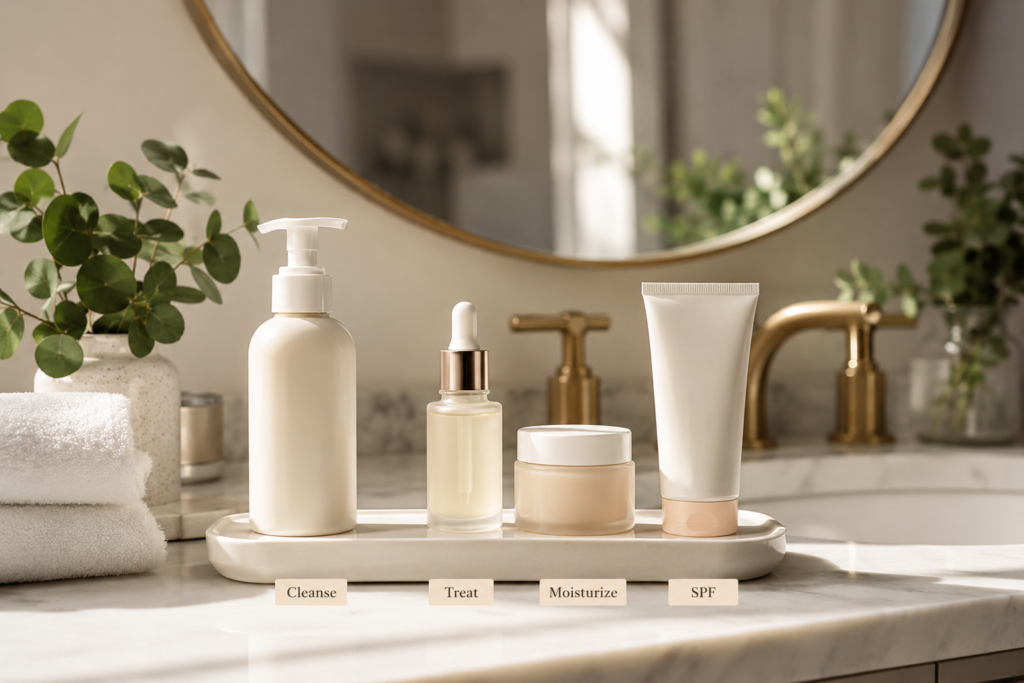
Simple 20s Morning Routine
Step 1: Cleanse
Use a gentle cleanser if you need one.
If your skin is dry and comfortable in the morning, some people may prefer a simple rinse instead.
Step 2: Optional treatment
If you’re targeting dark spots or uneven tone, you might consider a vitamin C product.
Step 3: Moisturizer
Choose one appropriate for your skin type.
Step 4: Sunscreen
Finish with broad-spectrum SPF 30+.
Simple 20s Night Routine
- Remove makeup/sunscreen.
- Cleanse gently.
- Apply a targeted treatment if needed.
- Moisturize.
If you’re considering a retinoid, start cautiously rather than adding it alongside several other active ingredients.
Skincare in Your 30s
Your 30s aren’t a deadline for suddenly needing “anti-aging” skincare.
Instead, this can be a good time to become more intentional about:
- Sun protection
- Hydration
- Uneven pigmentation
- Acne
- Texture
- Fine lines
Some people also choose to introduce retinoids or antioxidants depending on their concerns.
AAD notes that retinoids can be useful for concerns such as mild fine lines, pigmentation irregularities, acne and texture, but they can also irritate the skin if introduced too aggressively.
30s Morning Routine
1. Gentle cleanser
↓
2. Optional antioxidant
↓
3. Moisturizer
↓
4. Broad-spectrum SPF 30+
30s Night Routine
1. Cleanse
↓
2. Targeted treatment
↓
3. Moisturizer
The important word here is targeted.
You don’t need a separate serum for every imaginable skin concern.
Skincare in Your 40s
In your 40s, some people notice changes in:
- Hydration
- Texture
- Fine lines
- Pigmentation
- Skin firmness
- Sensitivity
But again, these changes vary considerably between individuals.
AAD guidance for people in their 40s and 50s places strong emphasis on sun protection, healthy skincare habits, moisturizer and targeted anti-aging products.
The 40s Routine
Morning
Cleanse → antioxidant if desired → moisturizer → sunscreen
Evening
Cleanse → targeted treatment → moisturizer
If your skin becomes drier or more sensitive, simplify rather than automatically adding more products.
Skincare in Your 50s
Your 50s can be a good time to prioritize comfort and barrier support.
Many people find that products that once felt perfectly comfortable become drying or irritating.
Instead of constantly searching for stronger actives, focus on:
- Gentle cleansing
- Consistent moisturization
- Sun protection
- Targeted treatments you tolerate well
- Avoiding unnecessary irritation
Morning
- Gentle cleanse or rinse
- Optional treatment
- Moisturizer
- Broad-spectrum SPF 30+
Evening
- Gentle cleanser
- Targeted treatment if appropriate
- Richer moisturizer if needed
AAD’s guidance for skin in the 40s and 50s emphasizes these healthy foundational habits rather than relying exclusively on specialty “anti-aging” products.
Age-by-Age Skincare Comparison
| 20s | 30s | 40s | 50s+ | |
|---|---|---|---|---|
| Gentle cleanser | ✓ | ✓ | ✓ | ✓ |
| Moisturizer | ✓ | ✓ | ✓ | ✓ |
| Daily sunscreen | Essential | Essential | Essential | Essential |
| Antioxidant | Optional | Useful for some | Optional | Optional |
| Retinoid | Optional/concern-based | Optional/concern-based | Often considered | Optional/concern-based |
| Hydration focus | Moderate | Moderate | High | High |
| Barrier support | Important | Important | Very important | Very important |
| Exfoliation | Gentle if needed | Gentle if needed | Moderate/individual | Usually gentle |
The table is a guide, not a prescription. Your skin type, concerns, medications and sensitivity matter more than your age.
Morning Skincare Routine: Step by Step
Here’s the simplest order to remember:
1. Cleanse
Use a gentle cleanser if needed.
2. Treatment
Apply any lightweight treatment product.
Examples may include:
- Vitamin C
- Hydrating serum
- Other concern-specific products
3. Moisturizer
Apply enough to leave the skin comfortable without feeling excessively greasy.
4. Sunscreen
Apply your broad-spectrum sunscreen as directed on the label.
AAD recommends SPF 30 or higher and broad-spectrum coverage for routine sun protection.
Simple rule:
Thin → thick → sunscreen last.
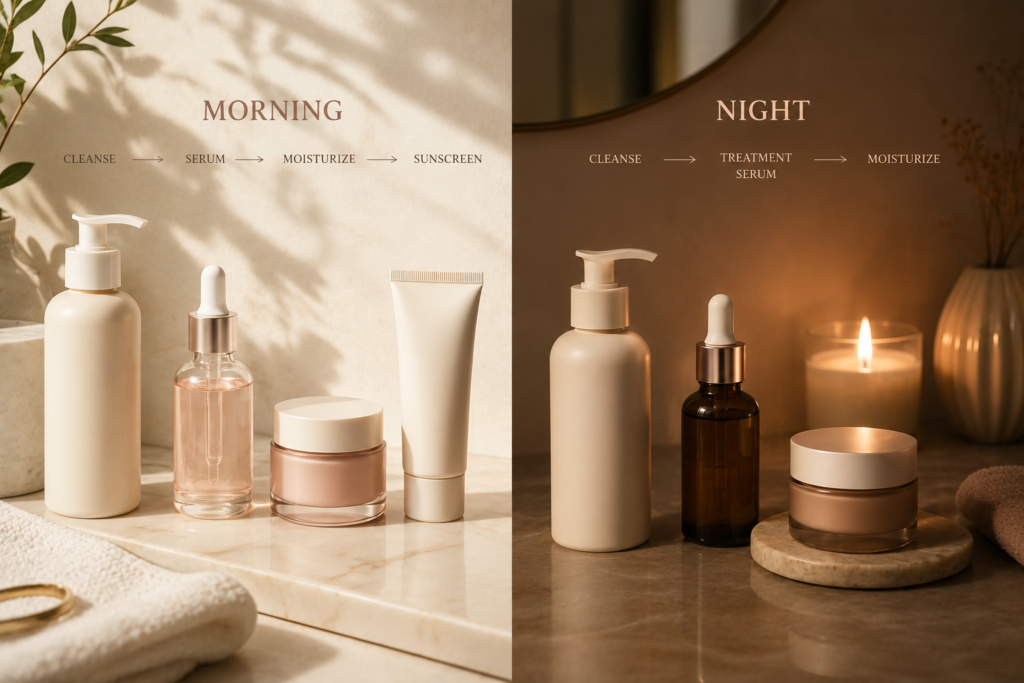
Nighttime Skincare Routine: Step by Step
Step 1: Remove makeup
If you’re wearing makeup, remove it gently.
Step 2: Cleanse
Wash away makeup, sunscreen and daily buildup.
Step 3: Treatment
This is where targeted ingredients can fit.
Step 4: Moisturize
Finish by supporting hydration.
Simple night routine:
Cleanse → Treatment → Moisturizer
That’s enough for many people.
Skincare Ingredients Explained
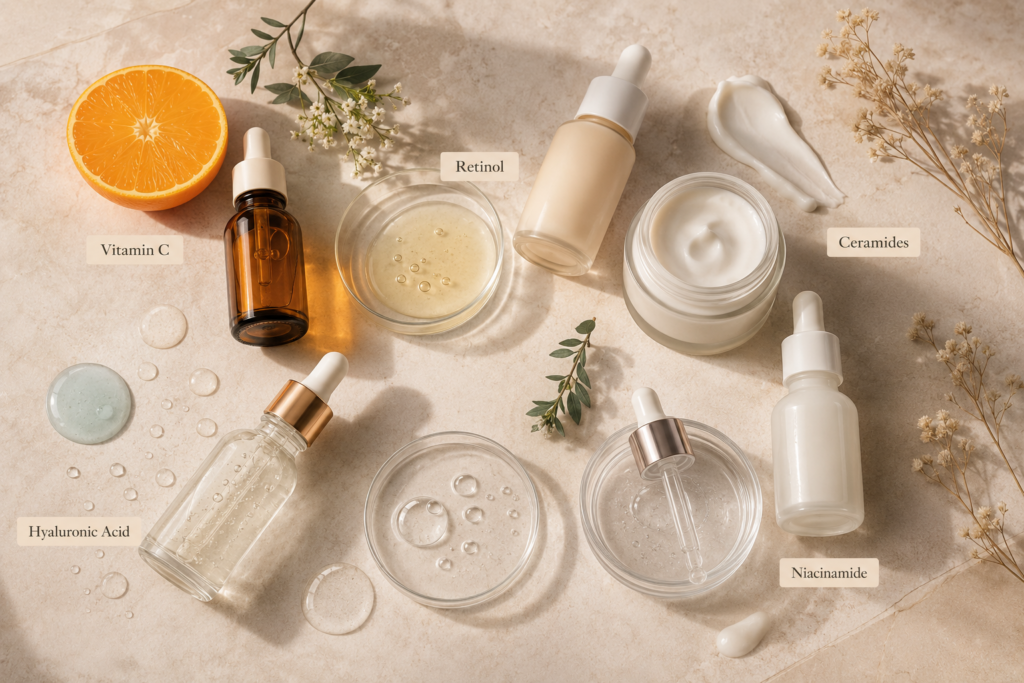
You don’t need to memorize dozens of ingredients.
Start with a few.
| Ingredient | Common reason people use it | When |
|---|---|---|
| Vitamin C | Antioxidant support, uneven tone | Morning often preferred |
| Retinol | Texture, fine lines, pigmentation | Usually evening |
| Hyaluronic acid | Hydration | AM/PM |
| Ceramides | Barrier support | AM/PM |
| Niacinamide | Oiliness, barrier/uneven tone support | AM/PM |
| Salicylic acid | Acne/oily skin | As tolerated |
| Peptides | Skin-conditioning/anti-aging products | AM/PM |
The important distinction is that ingredients aren’t automatically necessary just because they’re trendy.
Choose based on what you’re trying to improve.
Vitamin C: Who Might Benefit?
Vitamin C is commonly used as an antioxidant and can be helpful for people concerned about uneven tone or dark spots.
AAD’s guidance for people in their 20s lists vitamin C among ingredients that may help with skin aging and dark spots.
Simple way to use it
Morning:
Cleanse → Vitamin C → Moisturizer → Sunscreen
If your skin becomes irritated, reduce frequency or stop and reassess.
Retinol: What You Should Know
Retinol belongs to the retinoid family.
Retinoids can help with concerns such as acne, pigmentation irregularities, texture and fine lines, but they aren’t appropriate for everyone and can cause irritation.
The biggest mistake is starting too aggressively.
Don’t go from:
No retinoid → every night
Instead, introduce it gradually.
How to Introduce Retinol Slowly
Week 1–2
Use it once or twice per week, depending on the product directions and your tolerance.
Week 3–4
If your skin is comfortable, consider increasing gradually.
After that
Continue only as frequently as your skin tolerates and the product directions support.
You don’t win anything by irritating your skin.
AAD specifically advises starting slowly because irritation can become a problem with retinoids.
The “Moisturizer Sandwich” Method
If a retinoid feels drying, some people use moisturizer before and/or after the treatment.
Step 1
Cleanse gently.
Step 2
Apply moisturizer.
Step 3
Allow your skin to settle.
Step 4
Apply the retinoid according to its directions.
Step 5
Apply another layer of moisturizer if needed.
This can make a routine feel more comfortable for people who experience dryness.
Important Retinoid Warning
Do not use retinoids during pregnancy.
The American Academy of Dermatology advises avoiding retinoids during pregnancy because some retinoid ingredients can pose risks to the developing baby.
If you’re pregnant, trying to become pregnant, or breastfeeding and you’re unsure about a skincare ingredient, speak with your healthcare professional before using it.
How to Build a Simple Routine From Scratch
If your current skincare routine consists of ten products—or if you don’t have one at all—start here.
Phase 1: Build the foundation
For the first few weeks, focus on:
Cleanser + moisturizer + sunscreen
That’s it.
Phase 2: Identify your main concern
Ask:
What is the one thing I most want to improve?
Examples:
- Acne
- Dark spots
- Dryness
- Uneven texture
- Fine lines
- Sensitivity
Choose one targeted product.
AAD recommends introducing one anti-aging product at a time because using several new products together can irritate your skin and make it difficult to know what’s causing the reaction.
Phase 3: Give it time
Skincare rarely transforms overnight.
AAD notes that while moisturizer can improve the appearance of fine lines relatively quickly, many skincare products need several weeks of consistent use before results become noticeable.
A Simple 4-Week Skincare Reset
Week 1
Morning:
Moisturizer → Sunscreen
Evening:
Cleanser → Moisturizer
Week 2
Continue the same routine.
Pay attention to:
- Dryness
- Oiliness
- Irritation
- Breakouts
- Comfort
Week 3
If needed, introduce one targeted product.
Week 4
Evaluate.
Ask:
- Is my skin more comfortable?
- Am I less dry?
- Am I experiencing irritation?
- Is my routine easy enough to maintain?
If the routine is working and your skin is comfortable, don’t add products simply because you can.
How to Choose Products for Your Skin Type
Dry Skin
Look for:
- Cream-based moisturizers
- Ceramides
- Hydrating ingredients
- Gentle cleansers
Avoid unnecessarily aggressive cleansing.
Oily Skin
Look for:
- Lightweight moisturizers
- Gel or lotion textures
- Non-comedogenic products where appropriate
Remember: oily skin can still become dehydrated.
Combination Skin
You may need different textures in different areas.
For example:
- Lightweight moisturizer overall
- Slightly richer product on dry areas
Sensitive Skin
Keep the routine simple.
Introduce products one at a time.
AAD recommends patch-testing even products labeled hypoallergenic because reactions can still occur.
How to Patch-Test a New Product
Before putting a new active product all over your face:
Step 1
Choose a small area such as the inner forearm.
Step 2
Apply a small amount according to the product’s instructions.
Step 3
Repeat as directed over several days.
Step 4
Watch for:
- Redness
- Itching
- Burning
- Swelling
- Irritation
AAD suggests testing products on the inner forearm twice daily for four to five days before applying them more broadly.
If you develop a significant reaction, stop using the product and seek medical advice if needed.
Skincare Mistakes to Avoid
Mistake #1: Buying products because you’re a certain age
Being 40 doesn’t automatically mean you need every “40+” product.
Your skin decides.
Mistake #2: Using too many active ingredients
More isn’t always better.
Introducing several strong products at once increases the chance of irritation.
Mistake #3: Skipping sunscreen
This is one of the biggest missed opportunities in an anti-aging routine.
UV exposure contributes to premature skin aging and increases skin-cancer risk.
Mistake #4: Scrubbing aggressively
Skin doesn’t need to feel stripped to be clean.
Mistake #5: Changing products every week
Give your routine enough time to evaluate whether it’s working.
Mistake #6: Expecting a cream to erase wrinkles
Skincare can improve the appearance of certain concerns, but creams cannot reproduce the results of procedures such as a facelift.
AAD specifically recommends having realistic expectations about anti-aging products.
A Quick Skincare Routine Builder
Use this simple formula.
If you’re in your 20s:
Cleanse → Moisturize → SPF
Add a treatment only if you have a specific concern.
If you’re in your 30s:
Cleanse → Optional antioxidant → Moisturize → SPF
Night:
Cleanse → Targeted treatment → Moisturize
If you’re in your 40s:
Gentle cleanse → Treatment → Moisturize → SPF
Night:
Cleanse → Targeted treatment → Richer moisturizer if needed
If you’re in your 50s+:
Gentle cleanse/rinse → Hydrating treatment → Moisturizer → SPF
Night:
Cleanse → Appropriate treatment → Barrier-supporting moisturizer
What About Your Neck and Hands?
Don’t stop your skincare at your jawline.
Your:
- Neck
- Chest
- Hands
- Ears
can also receive significant sun exposure.
When applying sunscreen, extend it to exposed areas such as the neck and hands.
You don’t necessarily need a separate expensive “neck cream.”
A suitable moisturizer and sunscreen can often be incorporated into the same routine.
How Much Skincare Do You Actually Need?
A simple routine might contain:
Morning
2–4 products
Evening
2–4 products
That’s enough.
You don’t need a shelf full of bottles to have a thoughtful routine.
A better strategy is:
Consistency > complexity
and
targeted products > random products.
When to See a Dermatologist
Consider professional advice if you’re dealing with:
- Persistent or severe acne
- Significant redness
- Persistent itching
- Painful skin
- Severe dryness
- A changing mole or unusual skin growth
- Persistent pigmentation changes
- A reaction that doesn’t improve after stopping a product
A dermatologist can determine whether what looks like a cosmetic concern is actually a skin condition requiring treatment.
Frequently Asked Questions
What is the most important skincare product at every age?
For daily anti-aging and skin-health purposes, broad-spectrum sunscreen is one of the most important products to prioritize. Moisturizer is another foundational product.
Should I use retinol in my 20s?
Not everyone needs retinol in their 20s. It can be useful for specific concerns such as acne, pigmentation or texture, but it can also irritate skin. Your routine should be based on your concerns and tolerance rather than your age alone.
Is skincare different in your 40s?
It can be. Some people experience increased dryness, texture changes, pigmentation or fine lines. The foundation remains the same: gentle cleansing, moisturizing and sun protection, with targeted treatments added as appropriate.
Do I need an eye cream after 40?
Not necessarily. An eye cream can be a useful cosmetic product if you like its texture or ingredients, but you don’t automatically need one because you reached a particular age.
Do I need expensive skincare?
No. A higher price doesn’t automatically mean a product will work better. AAD notes that effective anti-aging products are available across different price ranges.
Can I use vitamin C and retinol together?
They don’t necessarily have to be used in the same application. A simple approach is often vitamin C in the morning and a retinoid at night, if both are appropriate for your skin and tolerated.
What should I use for dry skin as I get older?
Focus on gentle cleansing, moisturizer and barrier-supportive ingredients. You may also need to reduce how often you use potentially irritating active ingredients.
How often should I exfoliate?
There’s no universal number that works for everyone. If your skin becomes irritated, tight or uncomfortable, you’re likely doing too much. Many people don’t need aggressive exfoliation at all.
The Biggest Skincare Lesson at Every Age
Your skincare routine doesn’t need to become more complicated every birthday.
Instead, think of it as a foundation that evolves.
In your 20s:
Build consistent habits.
In your 30s:
Identify your concerns and stay consistent.
In your 40s:
Prioritize hydration, texture and continued sun protection.
In your 50s:
Protect your skin barrier, maintain hydration and keep protecting your skin from UV exposure.
And throughout every decade:
Cleanse gently.
Moisturize.
Protect your skin from the sun.
Introduce active ingredients slowly.
Don’t overwhelm your skin.
That’s a much more sustainable approach than chasing every new skincare trend.
Final Skincare Checklist
Before buying another serum, ask yourself:
☐ Do I use sunscreen consistently?
☐ Do I have a moisturizer that works for my skin?
☐ Is my cleanser gentle enough?
☐ What is my main skin concern?
☐ Do I actually need another active ingredient?
☐ Am I introducing new products one at a time?
☐ Am I giving products enough time to work?
☐ Am I protecting my neck and hands from sun exposure?
☐ Am I paying attention to irritation?
☐ Would a dermatologist be more appropriate for my concern?
If you can answer those questions, you already have a much stronger foundation than someone with a bathroom full of products but no consistent routine.
Your best skincare routine isn’t necessarily the longest one. It’s the one your skin tolerates, your lifestyle can maintain, and you can stick with consistently.