
Your nighttime routine can make a surprisingly big difference in how your hair looks and feels the next morning.
While sleeping won’t magically repair damaged hair, the hours you spend in bed can either reduce unnecessary friction, tangling and tension or quietly add to them. Your pillowcase, hairstyle, drying habits, products and even the way you detangle before bed can all influence how manageable your hair feels the next day.
The good news? You don’t need a complicated 20-step routine.
A few simple habits can help you wake up with less tangling, fewer unnecessary snags, better moisture management and hair that’s easier to style.
This guide covers 13 practical before-bed hair care tips, plus routines for straight, wavy, curly, coily, fine and thick hair, common nighttime mistakes, a simple 10-minute routine and a checklist you can actually follow.
Table of Contents
- What Happens to Your Hair While You Sleep?
- 13 Hair Care Tips Before Bed
- The Best Night Routine for Your Hair Type
- Silk vs. Satin: What Should You Use?
- Should You Sleep With Wet Hair?
- The 10-Minute Before-Bed Hair Routine
- What to Avoid Before Going to Bed
- How Often Should You Do a Nighttime Hair Routine?
- Weekly Nighttime Hair Schedule
- How to Build a Routine That Actually Works
- Frequently Asked Questions
- Final Takeaway
What Happens to Your Hair While You Sleep?
Hair doesn’t stop existing just because you’re asleep.
As you move around during the night, your hair repeatedly comes into contact with your pillow, sheets and clothing. This creates friction, and loose strands can become tangled or compressed.
For some people, this isn’t a major issue. For others—especially those with curly, coily, long, dry, fine or easily tangled hair—the difference can be noticeable.
Your nighttime routine can affect several things:
| Nighttime factor | What it can affect |
|---|---|
| Pillow friction | Tangling and frizz |
| Tight hairstyles | Tension around the hairline |
| Wet hair | Increased vulnerability to mechanical damage |
| Aggressive brushing | Breakage and unnecessary pulling |
| Heavy products | Greasy or weighed-down hair |
| Loose protective styling | Less movement and tangling |
| Dirty pillowcases | Product, oil and sweat buildup |
| Consistency | How manageable your hair feels over time |
The goal isn’t to make your hair “perfect” overnight.
Instead, think of your nighttime routine as a way to minimize unnecessary stress on your hair before the next morning.
13 Hair Care Tips Before Bed
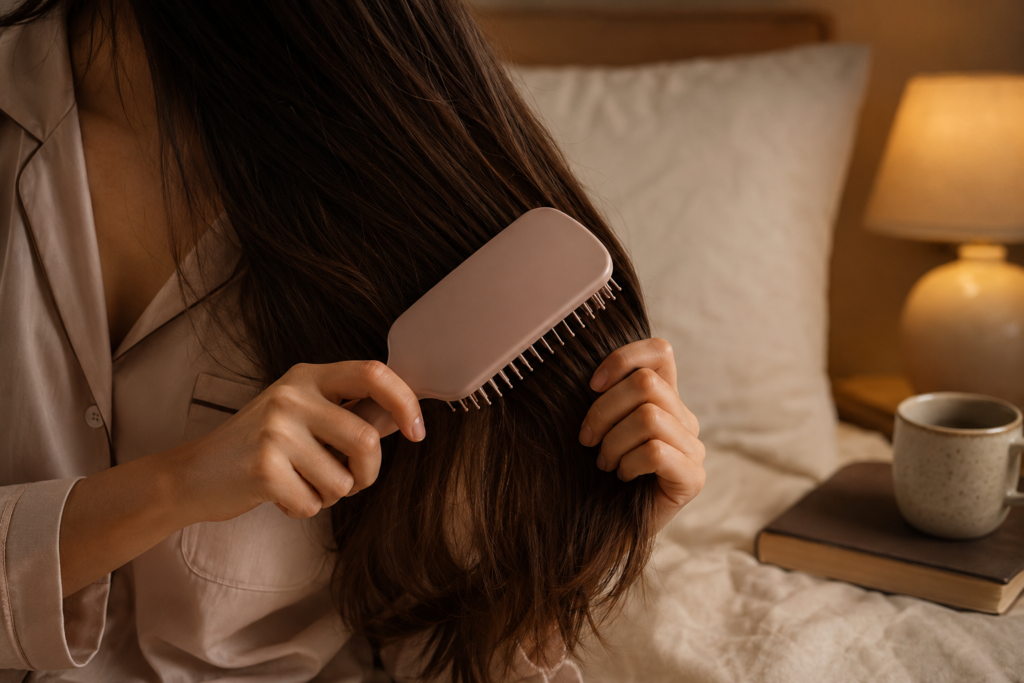
1. Gently Detangle Your Hair Before Sleeping
Going to bed with a large knot at the back of your head is rarely a recipe for an easy morning.
If your hair tangles easily, spend a few minutes gently detangling it before bed.
Start at the ends, not the roots.
Work through the lower section first, then gradually move upward.
A gentler detangling method
- Separate your hair into manageable sections.
- Hold the hair above the area you’re brushing to reduce pulling at the scalp.
- Start at the ends.
- Work upward a little at a time.
- Stop when you encounter resistance rather than forcing the brush through.
- Finish with gentle strokes through the full length.
For curly or coily hair, detangling may be easier when the hair is appropriately conditioned or damp rather than completely dry, depending on your curl pattern and routine.
The important thing is gentle handling, not a particular brush.
Don’t brush just for the sake of brushing
If your hair doesn’t tangle easily, you don’t need to aggressively brush it 100 times before bed.
The goal is to remove problematic tangles—not create unnecessary manipulation.
2. Don’t Go to Bed With Soaking-Wet Hair

This is one of the most common nighttime hair questions.
Hair is more vulnerable to mechanical damage when wet, and sleeping on wet hair can increase rubbing, tangling and stretching while you move during the night.
That doesn’t mean going to bed with slightly damp hair will automatically ruin your hair.
The better rule is:
Avoid going to bed with hair that is soaking wet whenever possible.
If you shower at night, gently squeeze out excess water and allow your hair to dry substantially before going to bed.
If you absolutely need to sleep with damp hair
Try to:
- remove as much excess water as possible
- avoid tight hairstyles
- avoid aggressive brushing
- keep the hair in a comfortable loose style
- use a low-friction pillowcase
- make sure the scalp isn’t staying excessively damp for long periods
For people with scalp conditions, persistent scalp moisture or irritation is something to discuss with a dermatologist rather than trying to solve solely with hair products.
3. Choose a Loose Protective Hairstyle
Leaving long hair completely loose isn’t always the best option if you wake up with a huge tangle every morning.
A loose hairstyle can reduce movement and help keep the lengths more controlled.
Good options can include:
- loose braid
- loose low ponytail
- loose bun
- pineapple-style arrangement for curls
- other gentle protective styles suited to your hair type
The key word is loose.
A hairstyle that feels comfortable at first but becomes tight during the night isn’t ideal.
Nighttime hairstyle comparison
| Style | Good for | Watch out for |
|---|---|---|
| Loose braid | Long, straight or wavy hair | Don’t braid tightly |
| Loose low bun | Longer hair | Avoid strong tension |
| Loose ponytail | Simple protection | Use a gentle tie |
| Pineapple | Many curly styles | Keep it loose |
| Hair left down | Short hair | May increase tangling |

You don’t need the same hairstyle every night. Choose based on your hair texture, length and comfort.
4. Avoid Tight Hair Elastics
A tight ponytail may look neat, but wearing a high-tension hairstyle repeatedly can put stress on the hair and scalp.
This is especially important around areas that are already fragile, such as:
- temples
- hairline
- edges
- areas where hair is naturally thinner
Instead, choose a soft, comfortable accessory that holds the hair without squeezing it tightly.
If your hairstyle leaves your scalp feeling sore, that is a good reason to loosen it.
5. Reduce Pillow Friction
This is one of the easiest nighttime changes to experiment with.
Traditional cotton pillowcases aren’t inherently bad for your hair, but some people find that smoother fabrics create less friction and help reduce morning tangling and frizz.
Silk and satin pillowcases are popular for this reason.
Silk vs. satin
| Feature | Silk | Satin |
|---|---|---|
| What it is | Natural fiber | A type of weave/finish |
| Smooth surface | Yes | Usually |
| Hair-friendly option | Yes | Yes |
| Typical cost | Often higher | Often more affordable |
| Easy to find | Common | Very common |
| Main benefit | Smooth surface + natural fiber | Smooth, low-friction surface |
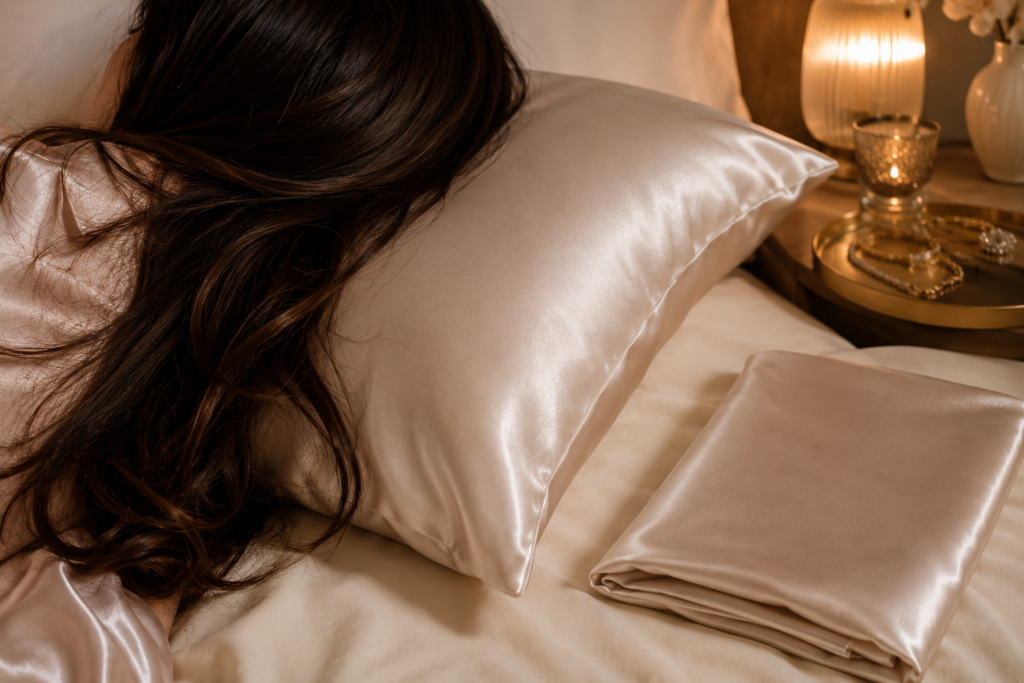
The important factor isn’t simply the word “silk.”
What matters for your hair is having a smooth surface that doesn’t create excessive friction.
6. Apply Products Mainly Where Your Hair Needs Them
Not everyone needs a nighttime hair product.
If your hair is already balanced and manageable, you may not need to add anything.
But if your lengths and ends feel dry or rough, a small amount of an appropriate leave-in conditioner, serum or oil may help with manageability.
Think about placement
For many people:
Scalp: Keep heavy products away unless the product is specifically intended for scalp use.
Mid-lengths: Use according to your hair’s needs.
Ends: Often the area that benefits most from conditioning and smoothing.
The “less is more” rule
Start with a small amount.
You can always add more.
You can’t easily remove three pumps of heavy oil without washing your hair.
7. Give Your Scalp a Gentle Massage
A short scalp massage can feel relaxing at the end of the day.
Use your fingertips rather than your fingernails and apply gentle pressure.
Try:
- Place your fingertips on the scalp.
- Make small circular movements.
- Move from the front toward the back.
- Continue for one to two minutes.
- Stop if anything feels painful or irritating.
The main benefit here is relaxation and a pleasant self-care ritual.
Don’t treat scalp massage as a guaranteed hair-growth treatment. If you’re experiencing significant hair loss, a massage isn’t a substitute for finding the underlying cause.
8. Protect Curly and Coily Hair From Overnight Compression
Curly and coily hair often has different nighttime needs from straight hair.
Repeated friction can disrupt the curl pattern and contribute to morning frizz and tangling.
Depending on your texture, you might experiment with:
- a loose pineapple
- a satin or silk bonnet
- a satin pillowcase
- loose twists
- loose braids
- a suitable protective style
The best option depends on your curl pattern and how your hair responds.
Curly/coily nighttime rule
Don’t try to force your hair into a style that changes your curl pattern dramatically.
The goal is to preserve your hair, not flatten it.
9. Keep Your Pillowcase Clean
Your pillowcase collects more than you might realize:
- sweat
- natural oils
- skincare products
- hair products
- dust
- dead skin cells
That doesn’t mean you need to wash it obsessively.
But regularly changing and washing your pillowcase is a simple hygiene habit.
If you use heavy hair products or sweat significantly during sleep, you may find that your pillowcase needs washing more frequently.
10. Don’t Tie Your Hair Up Tightly to “Protect It”
There’s a common misconception that the tighter your nighttime hairstyle, the more protected your hair is.
It’s actually the opposite.
A protective hairstyle should protect the hair without creating unnecessary tension.
If you wake up with:
- scalp soreness
- headaches
- tenderness
- tension around your hairline
your nighttime hairstyle is probably too tight.
Try loosening it or changing the style.
11. Protect Your Ends
Your ends are the oldest part of your hair.
They’ve been exposed to washing, brushing, styling, sunlight and environmental stress for longer than the newer hair near your roots.
If your ends are prone to dryness or tangling, give them some attention before bed.
Depending on your hair type, this could mean:
- a small amount of leave-in conditioner
- a lightweight serum
- a tiny amount of oil
- a loose braid
- a gentle protective style
You don’t need to coat the entire head in product.
Focus on what actually needs attention.
12. Give Your Hair a Break From Heat at Night
If you’ve spent the day using:
- a flat iron
- curling iron
- hot brush
- blow dryer
you don’t need to add more heat at bedtime.
Nighttime is an opportunity to leave your hair alone.
If you’re trying to preserve a blowout or styled look, use gentle techniques rather than reheating the hair every evening.
And when using heat tools in general, use an appropriate heat protectant and follow the product’s directions.
13. Be Consistent Instead of Complicated
This might be the most useful tip of all.
You don’t need:
- 10 serums
- 5 oils
- overnight masks every day
- complicated hairstyles
- a different routine every night
A simple routine you actually follow is more useful than an elaborate routine you abandon after four days.
A realistic routine might be:
Detangle → condition if needed → loose protective style → sleep.
That’s enough for many people.
Your Nighttime Routine by Hair Type
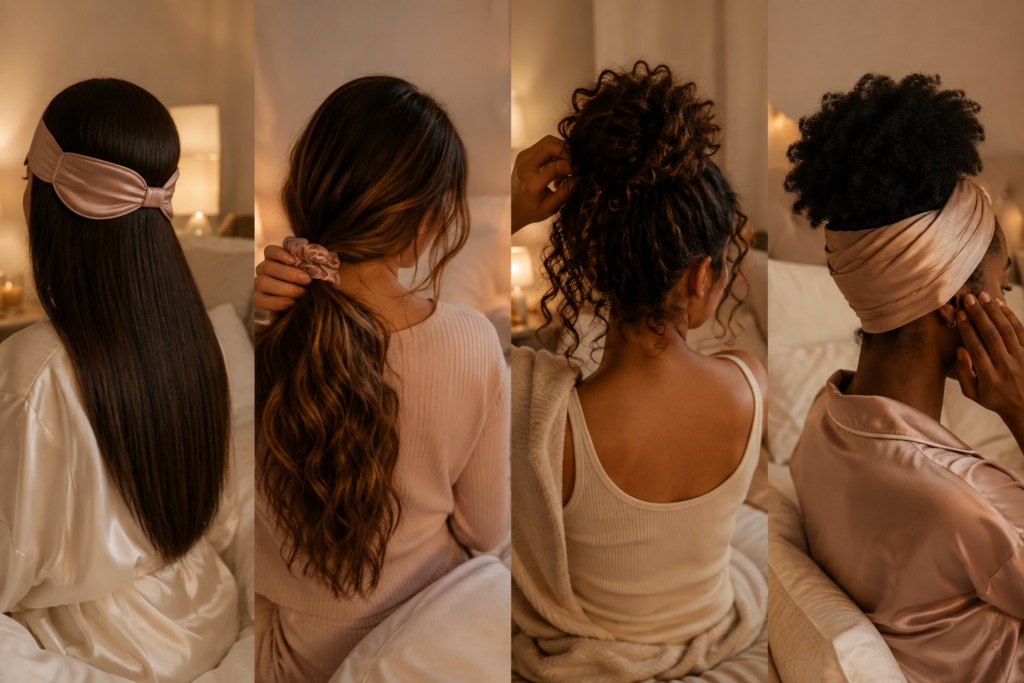
Your hair texture matters more than following a generic routine from social media.
Straight Hair
Straight hair may show oil and buildup more quickly, especially if the hair is fine.
Try:
- gentle detangling
- lightweight products
- loose styling
- minimal product near the roots
- smooth pillowcase if tangling is an issue
Avoid:
- excessive oil
- heavy overnight products
- tight ponytails
Wavy Hair
Wavy hair can lose its shape overnight.
Try:
- gentle detangling when appropriate
- lightweight leave-in product
- loose braid if you want softer waves
- gentle overnight protection
Avoid brushing aggressively if it causes your waves to become overly fluffy.
Curly Hair
Curly hair often benefits from reducing friction and unnecessary manipulation.
Try:
- loose pineapple
- satin/silk pillowcase
- suitable bonnet
- lightweight leave-in product
- refreshing only where needed in the morning
Don’t overload your curls with heavy products simply because you’re going to sleep.
Coily Hair
Coily hair can be particularly vulnerable to dryness and tangling depending on the individual hair characteristics and routine.
Consider:
- moisturizing according to your established routine
- protective styling
- satin/silk accessories
- gentle handling
- protecting the ends
Avoid excessive manipulation every night.
Fine Hair
Fine hair can become weighed down easily.
Try:
- very lightweight products
- minimal oils
- gentle brushing
- loose hairstyles
- clean pillowcases
You may need less product than you think.
Thick Hair
Thick hair may benefit from dividing it into sections before creating a loose protective style.
Try:
- gentle sectioning
- loose braids or twists
- lightweight products distributed through the lengths
- extra attention to the ends
What Should You Put in Your Hair Before Bed?
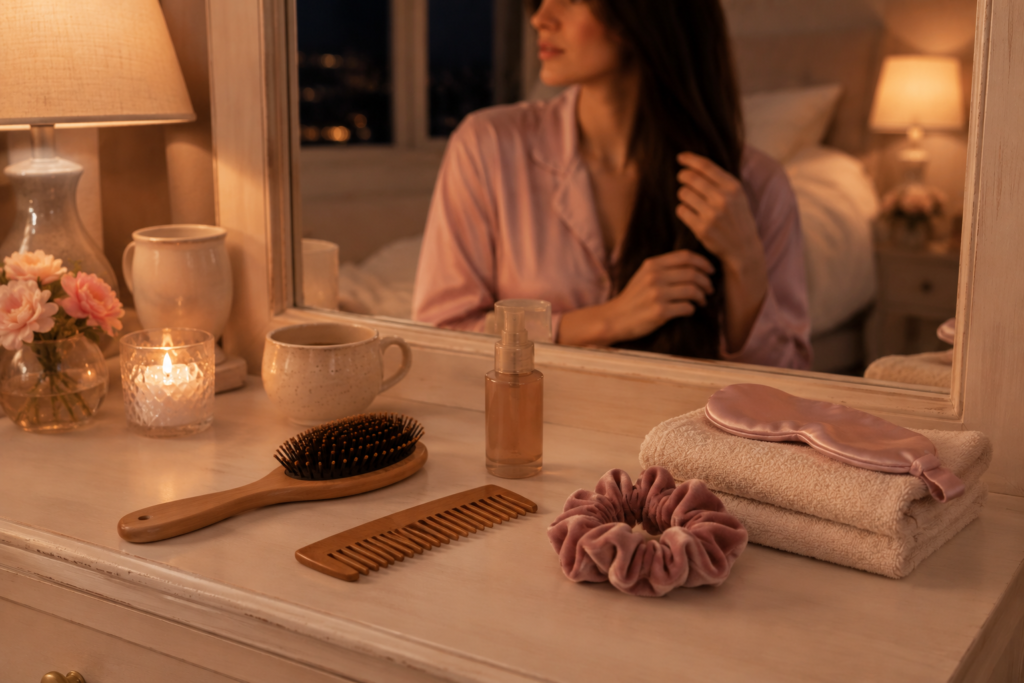
There’s no universal product that everyone needs.
Instead, choose based on what your hair is actually missing.
| Your concern | Possible option |
|---|---|
| Tangling | Leave-in conditioner/detangler |
| Dry ends | Lightweight oil or serum |
| Frizz | Smoothing serum |
| Curly definition | Curl-friendly leave-in/product |
| Fine hair | Lightweight conditioner or leave-in |
| Oily roots | Avoid heavy products near scalp |
| Normal, healthy hair | Possibly nothing |
Remember that more product doesn’t automatically mean more moisture.
If your hair feels coated, greasy or limp the next morning, you’re probably using too much or using a product that’s too heavy for your hair.
Silk or Satin: Which Should You Choose?
You don’t necessarily need an expensive silk pillowcase to create a better nighttime environment for your hair.
A good-quality satin surface can also provide a smooth sleeping surface.
If you’re deciding between the two, consider:
Choose silk if:
- you prefer a natural fiber
- you’re comfortable spending more
- you like the feel of silk
Choose satin if:
- you want a more budget-friendly option
- you want a smooth surface
- you care more about function than fiber type
The goal is less unnecessary friction, not owning a particular luxury product.
Should You Sleep With Wet Hair?
Ideally, allow your hair to dry substantially before going to bed.
Wet hair is more vulnerable to stretching and mechanical damage, and rubbing wet hair against bedding can contribute to tangling and breakage.
But there’s an important distinction:
Damp hair isn’t the same thing as soaking-wet hair.
If your hair is slightly damp and you occasionally fall asleep before it is completely dry, don’t panic.
Instead, make it a habit to:
- Remove excess water.
- Gently detangle if appropriate.
- Let your hair air-dry or partially dry.
- Avoid tight hairstyles.
- Minimize friction while sleeping.
The 10-Minute Before-Bed Hair Routine
You don’t need an hour-long ritual.
Here’s a simple routine that takes approximately 5–10 minutes.
Minute 1–2: Check Your Hair
Ask:
Is it tangled?
Is it dry?
Is it oily?
Is it still wet?
Your answer determines what you actually need.
Minute 2–4: Detangle
Work gently from the ends upward.
Don’t force stubborn knots.
Minute 4–6: Add Product If Needed
Apply a small amount of leave-in conditioner, serum or oil to the areas that need it.
Skip this step if your hair doesn’t need it.
Minute 6–8: Choose Your Night Style
Choose something loose and comfortable.
For example:
Straight hair → loose braid
Wavy hair → loose braid or gentle arrangement
Curly hair → pineapple or suitable curl-protecting style
Coily hair → preferred protective style
Minute 8–10: Prepare Your Sleep Environment
Make sure:
- your pillowcase is reasonably clean
- your hair isn’t trapped underneath you
- your hairstyle isn’t pulling
- you’re not going to bed with soaking-wet hair
Done.
What NOT to Do Before Bed
Sometimes knowing what to stop doing is more useful than adding another product.
| Nighttime mistake | Better approach |
|---|---|
| Sleeping with soaking-wet hair | Let it dry substantially first |
| Tight ponytail | Use a loose style |
| Aggressive brushing | Detangle gently |
| Too much oil | Start with a tiny amount |
| Heavy product on fine hair | Choose something lightweight |
| Tight bun every night | Alternate gentle styles |
| Constant heat styling | Give your hair a break |
| Ignoring tangled ends | Detangle before bed |
| Never changing pillowcases | Wash them regularly |
| Copying another person’s routine | Adapt it to your hair |
A Simple Weekly Nighttime Hair Schedule

You don’t need to do everything every night.
Here’s an example:
| Night | Routine |
|---|---|
| Monday | Gentle detangle + loose style |
| Tuesday | Detangle + lightweight product if needed |
| Wednesday | Simple protective style |
| Thursday | Scalp massage + gentle styling |
| Friday | Minimal manipulation |
| Saturday | Wash/condition routine if scheduled |
| Sunday | Gentle detangle + prepare for the week |
The exact schedule should follow your normal washing and styling routine.
How to Build a Night Routine That Actually Works
If you’ve tried complicated hair routines before and stopped using them, simplify.
Step 1: Identify Your Biggest Problem
Don’t try to solve everything.
Choose one:
- morning tangles
- frizz
- dryness
- flattened curls
- oily roots
- breakage
- uncomfortable hairstyles
Step 2: Change One Thing
For example:
If tangling is your problem, try a loose braid.
If friction is your problem, try a smoother pillowcase.
If dryness is your problem, reconsider your conditioning routine.
Step 3: Give It Time
Don’t judge a new routine after one night.
Look at how your hair behaves over several weeks.
Step 4: Remove What Isn’t Helping
If a product leaves your hair greasy, stop using it.
If a hairstyle makes your scalp sore, change it.
If brushing makes your hair frizzy, rethink when and how you brush.
Step 5: Keep the Routine Small
Your ideal nighttime routine might only have three steps.
That’s completely fine.
A “Lazy Girl” 3-Step Night Hair Routine
For nights when you have absolutely no energy:
1. Detangle gently
Focus on obvious knots.
2. Put your hair in a loose protective style
Choose the simplest comfortable option.
3. Sleep on a smooth pillowcase
Done.
You don’t need a complicated routine every night to take better care of your hair.
When Your Nighttime Hair Routine Needs to Change
Your hair needs can change with:
- seasons
- length
- chemical treatments
- coloring
- heat styling
- hormonal changes
- changes in washing frequency
- changes in humidity
- different hairstyles
For example, a routine that works perfectly in humid summer weather may feel too heavy during a dry winter.
Pay attention to how your hair responds rather than following a routine permanently just because it worked once.
When to Pay Attention to Hair or Scalp Changes
Nighttime hair care can help with everyday manageability, but it can’t solve every hair problem.
If you’re experiencing:
- significant or sudden hair loss
- persistent scalp itching
- painful scalp
- scaling
- sores
- unexplained changes in hair texture
- persistent breakage despite gentle care
consider speaking with a dermatologist or another qualified healthcare professional.
A nighttime routine shouldn’t be used to self-treat an underlying scalp or hair condition.
Frequently Asked Questions
Is it good to brush your hair before bed?
If your hair becomes tangled, gentle detangling before bed can make it easier to manage. However, excessive or aggressive brushing isn’t necessary and can create unnecessary mechanical stress.
Is sleeping with wet hair bad?
It’s better to avoid going to bed with soaking-wet hair because wet hair is more vulnerable to mechanical damage. Allow it to dry substantially when possible and avoid tight hairstyles while it’s wet.
Does a silk pillowcase really help hair?
A smooth silk or satin surface can reduce friction compared with rougher sleeping surfaces, which may help some people experience less tangling and frizz. It isn’t a treatment for damaged hair, though.
Should I oil my hair before bed?
You can use a small amount of a suitable hair oil if your lengths or ends benefit from it. However, oil isn’t necessary for everyone, and using too much can make hair greasy or weighed down.
Is it better to sleep with your hair up or down?
There’s no single answer. A loose protective style can help reduce tangling for longer hair, while very short hair may be perfectly comfortable left down. The important thing is avoiding excessive tension.
Should I braid my hair before bed?
A loose braid can be useful for reducing tangling and can also create gentle waves in some hair types. Avoid making it tight enough to pull on the scalp.
How should I sleep with curly hair?
Many people with curly hair experiment with a loose pineapple, satin/silk pillowcase, bonnet or other curl-protective method. The best choice depends on your curl pattern, length and what preserves your hair without creating tension.
How can I prevent morning frizz?
Reducing friction, avoiding unnecessary manipulation and choosing a nighttime style that works with your natural texture can help. A smooth pillowcase may also be useful.
Should I put conditioner in my hair overnight?
You don’t automatically need to leave regular conditioner in overnight. Use products according to their instructions. If you want an overnight treatment, choose one specifically formulated for that purpose.
How often should I wash my pillowcase for better hair?
There’s no single schedule that works for everyone. Change it regularly and consider washing it more often if you sweat heavily, use substantial hair products or notice buildup.
Can sleeping with a tight ponytail cause hair damage?
Repeated tension from tight hairstyles can contribute to hair breakage and, in some circumstances, traction-related hair loss. A loose, comfortable hairstyle is a better choice for sleeping.
Can a nighttime routine make damaged hair healthy again?
No nighttime routine can permanently reverse structural hair damage. Good habits can reduce additional mechanical stress and improve how hair looks and feels, while damaged ends may ultimately need trimming.
Your Before-Bed Hair Checklist
Save this checklist for tonight:
☐ Check whether your hair is tangled
☐ Detangle gently from the ends upward
☐ Avoid going to bed with soaking-wet hair
☐ Apply a small amount of product only if needed
☐ Protect dry ends if appropriate
☐ Choose a loose hairstyle
☐ Avoid tight elastics
☐ Consider a smooth satin or silk pillowcase
☐ Keep your pillowcase clean
☐ Avoid unnecessary heat
☐ Don’t overload your hair with products
☐ Make sure your hairstyle feels comfortable
☐ Keep the routine simple enough to repeat
Final Thoughts
The best nighttime hair routine isn’t necessarily the one with the most products.
It’s the one that reduces unnecessary friction, tension and manipulation while fitting your actual hair type and lifestyle.
For one person, that might mean a loose braid and a satin pillowcase. For another, it might mean a pineapple for curls and a lightweight leave-in conditioner. Someone with short, low-maintenance hair might only need to gently detangle and go to bed.
Start with the problem you notice most.
If you wake up tangled, focus on reducing friction. If your ends feel dry, reconsider how you’re conditioning them. If your scalp feels sore, loosen your hairstyle. If your hair is constantly weighed down, simplify your products.
Small habits are easier to maintain than complicated routines—and when it comes to nighttime hair care, consistency is far more useful than doing everything at once.